


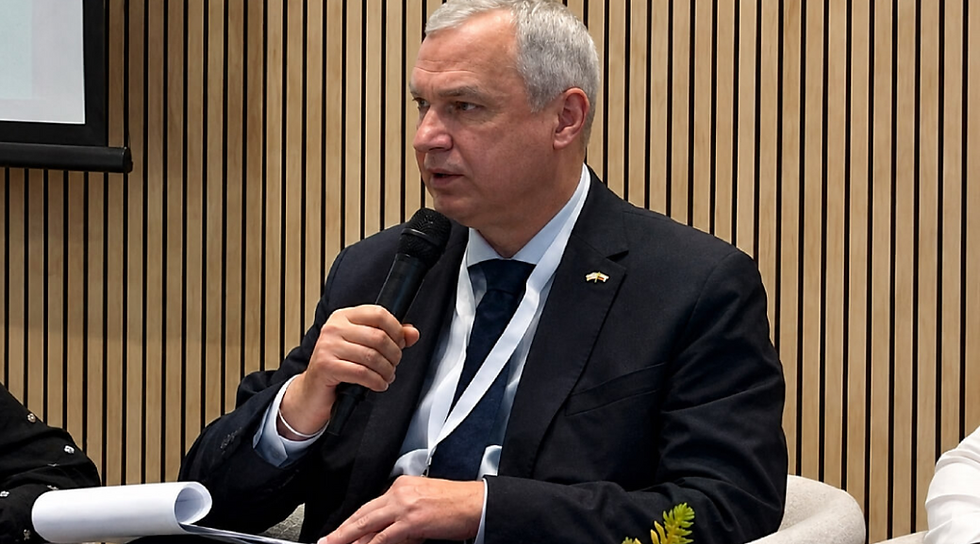
Pavel Latushka: "We are working to ensure that a court precedent similar to the case of Yury Harauski in Switzerland appears in Poland"


On 26 October, the Cantonal Court of St. Gallen in Switzerland found former SOBR officer Yury Harauski guilty of the enforced disappearance of Anatol Krasouski in 1999 and sentenced him to two years' imprisonment, suspended.
The ruling has become an important precedent for the exercise of universal jurisdiction over crimes related to political repression in Belarus.
Deputy Head of the United Transitional Cabinet and Head of the National Anti-Crisis Management Pavel Latushka, commenting on the court's decision, noted:
"It is very important that other countries adopt the positive experience of exercising universal jurisdiction. Unfortunately, today we can fully count on the use of this mechanism in only a few European countries. Nevertheless, the National Anti-Crisis Management does not give up its efforts to achieve the first such successful case in Poland, and we hope that the verdict against Harauski will contribute to the application of universal jurisdiction by courts in Poland."
The Harauski case was considered on the basis of Article 185bis of the Swiss Criminal Code, which provides for liability for enforced disappearance. This provision was introduced into Swiss legislation as part of the implementation of the International Convention for the Protection of All Persons from Enforced Disappearance.
"Enforced disappearance is not simply the abduction of a person. Both Article 185bis of the Swiss Criminal Code and Article 2 of the Convention provide for a state element of the crime: the deprivation of a person's liberty by agents of the state or by persons acting with its authorization, support or acquiescence, followed by a refusal to acknowledge the deprivation of liberty or by concealment of the fate or whereabouts of the disappeared person."
Harauski's conviction has significance that goes beyond the responsibility of a single perpetrator. Pavel Latushka emphasized:
"The court's application of Article 185bis means establishing the elements of the crime provided for by this provision, including the link between the crime committed and the state structures of Belarus. This creates an important basis for further investigation of the role of other representatives of the Belarusian authorities, including the organizers of the crime and the persons who gave the orders."
The court considered three episodes. In the case of Anatol Krasouski, Harauski was found guilty. In the case of Yury Zakharanka, the court established his involvement in the disappearance, but upheld the acquittal due to the lack of proof of the necessary specific intent "to remove the victim from the protection of the law for a prolonged period of time." In the case of Viktar Hanchar, the acquittal was upheld for procedural reasons: the appeal court did not review this episode on the merits. At the same time, the court found Harauski's testimony about his involvement in the disappearances of all three people to be credible.
For the families of the disappeared, this ruling is an important step towards justice after 27 years of struggle for the truth. But justice will not be complete until the whole truth about the fate of their loved ones has been established and all those responsible have been brought to account.
"Justice must not be limited to the responsibility of the direct perpetrator. It is necessary to establish the entire chain of responsibility, including the persons who planned and organized the crimes, gave the orders and ensured the concealment of the fate of the disappeared,"
— noted Pavel Latushka.
Special thanks go to the human rights organizations TRIAL International, FIDH and "Viasna," which made this result possible.


Comments