


"The Belarusian Corps": the infiltration of the Wagner PMC and other pro-Russian paramilitary structures into the security apparatus of the Republic of Belarus

On 7 September 2026, military unit 7404 of the Interior Troops of the Ministry of Internal Affairs held training sessions with "instructors with experience of participating in modern armed conflicts". Attention was paid to changing magazines correctly and choosing a firing position, to the procedure for handling weapons in a sudden encounter with the enemy, as well as to assuming firing positions and moving on the battlefield. "Another aspect covered was practising small-group tactics, including during the storming of buildings. The servicemen also accurately hit targets with the Makarov pistol and the Kalashnikov assault rifle," says a post on the Telegram channel of Lukashenko's Interior Troops.

It should be recalled that after Prigozhin's mutiny, some fighters of the notorious Wagner PMC were relocated to the territory of Belarus. At the time, it was reported that they were conducting training for Belarusian servicemen, and some fighters even joined Belarusian units. Throughout 2024, Lukashenko's security agencies regularly reported on training sessions involving "Wagnerites". Later, however, for some reason the "Wagnerites" stopped being mentioned.
It should be noted that supporting dictatorial regimes often becomes the main function of Russian mercenaries abroad, while the Kremlin gains a government interested in cooperating with Russia. This is how Russian advisers and military specialists operate in African countries. But is this strategy fundamentally different from the strategy towards Belarus? Let us take a closer look.
In October 2024, Moldova's Intelligence and Security Service published the names of Russians it considered to be involved in training Moldovan citizens at training camps in Bosnia and Herzegovina and Serbia. The instructors taught the recruits not only how to operate UAVs, but also how to organise riots ahead of the upcoming parliamentary elections in Moldova.
In the same year, 2024, EU law enforcement agencies began investigating a series of arson attacks, acts of vandalism and other acts of sabotage. A Telegram channel called "Privet-bot" was used to recruit perpetrators. This channel appeared long before the 2024 wave of sabotage. It was first promoted by Grey Zone, one of the largest Telegram channels linked to the Wagner PMC. Later, Grey Zone repeatedly published advertisements for the bot, including in French: residents of France were offered money to pass on information anonymously. These are examples from Europe. But what about Belarus?
After the events of 2020 and the start of Russia's full-scale war against Ukraine in 2022, the Lukashenko regime took an unprecedented step: the systematic transfer of the functions of training and equipping its own security agencies to irregular Russian formations.
Among them, an important role is played by such structures as the former Wagner PMC, as well as the Coordination Centre for Assistance to Novorossiya (CCAN) and veterans of the pro-Russian armed formations of the so-called "DPR" and "LPR".
An analysis of the available data indicates that a multi-level system for integrating Russian mercenaries into state structures has been formed in Belarus.
This system addresses three interrelated tasks:
Military and technological adaptation: preparing Belarus's security forces for hybrid and direct combat operations against Ukraine and NATO countries.
Internal terror: creating highly mobile repressive units geared towards methods of terror for total control over society.
Ideological hybridisation: introducing the ideology of the "Russian world" and the experience of militants into regular army and police units of Belarus.
The process of integrating Wagnerites into Belarus's security structures went far beyond ordinary consulting or the temporary placement of a camp in the village of Tsel near Asipovichy. What we are dealing with is a symbolic and institutional merger of the special forces of Belarus's Interior Ministry with Russian militants.
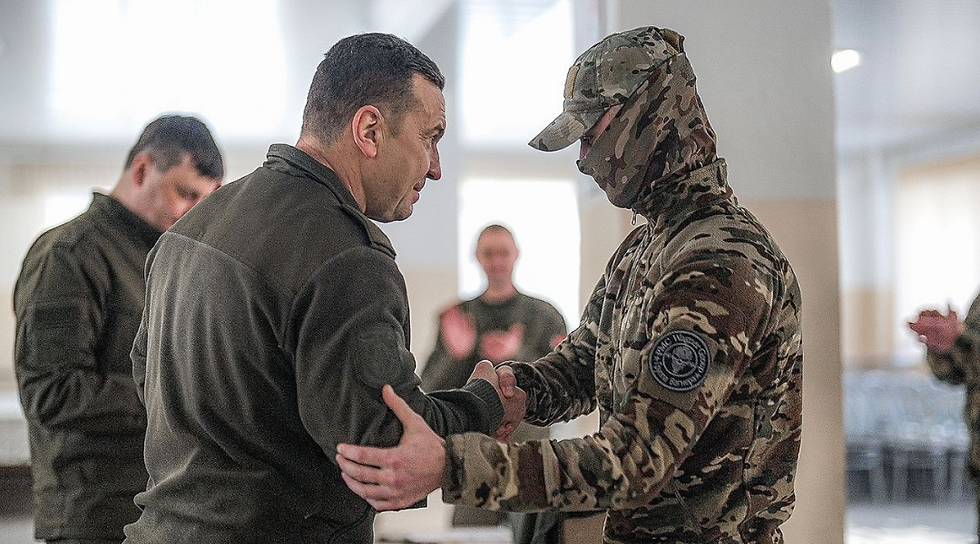
For example, the Commander of Lukashenko's Interior Troops and Deputy Minister Mikalai Karpenkau openly wears a non-regulation patch on his uniform that combines the symbols of the Interior Troops and the Wagner PMC.
In February 2024, following the 6th season of tactical and special training at the Valoushchyna training centre, servicemen of the Interior Ministry's special units began to be officially awarded the qualification patch "Wagner Group. Stormtrooper". It combines the abbreviation "Interior Troops of the Ministry of Internal Affairs of the Republic of Belarus" with Wagner symbols. The patch is awarded to fighters who have successfully completed a course under the guidance of Russian mercenaries.
Wagner PMC instructors not only train Belarusian special forces, but are also integrating into their elite themselves. In particular, a Wagner commander with the call sign "Brest" was officially awarded the maroon beret, the highest symbol of passing the special forces trials in Belarus.
At official events of Belarus's Interior Ministry, the symbols of the Russian PMC are displayed on a par with state symbols. For example, on 14 December 2023, during the presentation of the new special-purpose unit "Tornado" to the Interior Ministry leadership, Wagner PMC flags were officially raised on the flagpoles of the military unit and placed on combat vehicles.
The direct participation of foreign citizens in the ranks of Belarus's Interior Troops is restricted by law. To circumvent these restrictions, the regime used a scheme of covert passport issuance. The documents were issued on genuine blank forms, but with altered identity data (a cover identity).
The issuance of passports created the legal conditions for the direct enrolment of Wagner militants into the regular staff of the Interior Ministry's special units.
In recent years, the training of security forces by Wagner mercenaries and representatives of pro-Russian structures has become a conveyor belt.
By early 2024, 6 seasons of training camps had been held at the Valoushchyna training ground, through which more than 1,600 Belarusian special forces soldiers passed. The training was conducted directly by Wagner militants, who passed on their experience of urban combat and assault operations.
Wagner PMC instructors also conduct intensive training with elite units of Belarus's Special Operations Forces (SOF), in particular with the 38th Separate Guards Air Assault Brigade from Brest. Holding exercises in the immediate vicinity of the border with Poland is a direct element of pressure and of preparation for a potential clash with NATO forces.
Wagnerites are also involved in training reservists of Belarus's territorial troops. The programme includes tactical medicine, engineering training, tactical shooting and movement on the battlefield, taking into account the experience of the war in Ukraine.
In addition to the Wagner PMC, other Russian paramilitary and supply structures directly linked to Russian aggression in Ukraine are active in Belarus.
The Coordination Centre for Assistance to Novorossiya (CCAN) is an organisation that has been supplying pro-Russian formations in Donbas with equipment and communications since 2014. In Belarus, the CCAN operates at an official level.
In particular, the CCAN receives letters of gratitude from the Western Operational Command of the Armed Forces of Belarus for its contribution to improving the material and technical base. Information about this was published on the CCAN website in February 2026.
CCAN instructors conduct practical training camps for Interior Ministry units and army units. Lukashenko's security officers travel to exercises in the Moscow region, where they learn to work with fibre-optic drones (resistant to electronic warfare), and are sent to the Russian forum "Dronnitsa".

The CCAN holds closed briefings for the leadership of Belarus's special units, analysing the tactics of UAV use by Ukrainian forces and sabotage groups on Russian territory.
Belarus has continued integrating a network of military-patriotic and "Cossack" clubs, which have historically been used to recruit volunteers for Donbas and to indoctrinate young people. These structures serve as a reserve for staffing Belarus's security agencies with pro-Russian personnel.
In parallel with the external military vector, Russian militants and the leadership of Lukashenko's Interior Ministry are preparing the security structures for the harsh suppression of the Belarusian people's internal resistance.
Deputy Minister of Internal Affairs Mikalai Karpenkau publicly announced that the new special forces units ("Buran", "Tornado", "Granit" and others) are being formed on the basis of the experience of the "NKVD Chekist-military groups". This experience involves the methods used to fight the anti-Soviet underground and partisans in the post-war period (tracking, sweeps of forested areas, intelligence-led force operations).

Special forces soldiers are trained to operate in two modes:
In civilian clothes: for targeted reconnaissance, tracking and neutralising dissenters, activists and hypothetical partisans inside the country.
In heavy military uniform: for participation in combined-arms operations, as well as sabotage and counter-sabotage operations.
Training with Wagnerites and the CCAN is mainly undergone by security officers who took part in the harsh suppression of the 2020 protests. Russian instructors openly state that they work with commanders "who prevented the destruction of Belarus in 2020", thereby finally binding the Lukashenko regime and pro-Russian paramilitary groups together through mutual complicity.
The materials and facts demonstrate a hybrid annexation of the security apparatus of the Republic of Belarus by pro-Russian paramilitary elements.
Belarus's Interior Troops and SOF units under the leadership of Mikalai Karpenkau are effectively turning into a branch of Russian irregular forces, adopting their symbols and tactics and legally enrolling militants into their staff.
Training centres in Belarus have been switched to high-intensity warfare standards, with an emphasis on FPV drones, fibre-optic UAVs, mortar artillery and assault operations.
Lukashenko's security apparatus is adapting NKVD methods to fight its own citizens, using the experience of Russian militants to prepare for eliminating any manifestation of internal resistance.


Comments