


Lukashenko Has Set One Line — Toward the Abyss. But There Is an Alternative — the Elections


Sitting in the gilded chairs of the Palace of Independence today is no easy task.
For many ministers, directors, and officials of the vertical, these meetings have long since ceased to be strategy discussions and become psychological torture. You watch as the country's "chief economist," stuck in the methods of the last century, drags your enterprises and your careers into the abyss. But this year, each of you — and all Belarusians — has a real chance to change this scenario: from 11 to 17 May, elections to the Coordination Council will take place.
This is currently the only legal and safe way to form an alternative to the dictatorship. While the dictator once again searches for someone to blame for his own failures, it is time to acknowledge: we cannot go on living like this. While you avert your eyes before the cameras at yet another pointless meeting, we will answer the questions put to you that you are afraid to answer truthfully.
On 5 May, another act unfolded in the long-running drama known as "Dressing Down the Government." This time, the country's chief and irreplaceable economist gathered his loyal ministers and bankers to discuss, for the hundredth time, why his beloved projects — cement plants and agro-industrial complexes — are once again asking for money instead of generating it.
Lukashenko traditionally assumed the role of a stern auditor "alarmed by the flood of requests for handouts." He posed four questions to the room about the survival of the industry — questions that officials, nervously glancing at the State Control Committee, are unlikely to answer honestly. For in this system, the truth is the shortest path to dismissal or pre-trial detention.
Since the dictator will not receive objectivity from his entourage, we decided to assist Lukashenko and prepared the very answers that neither the Prime Minister and Deputy Prime Ministers, nor the heads of the State Control Committee, nor representatives of the National Bank, nor a number of ministers and regional executive committee chairmen — who sit at these meetings with eyes cast down — will ever dare to speak aloud.
This meeting is a classic example of "Groundhog Day" in the Belarusian economy. We see the same mise-en-scène again: the dictator reprimands officials for the fact that his own economic mega-projects have turned into bottomless budget pits.
1. What has the government already done for the development of the cement industry?
In short: under the strict control and guidance of Lukashenko, it drove the industry into a Chinese credit trap.
In 2007–2012, three cement plants — Krasnoselskstroymaterialy, the Belarusian Cement Plant, and Krichevtsementnoshifer — underwent forced modernisation financed by tied Chinese loans (over $1.2 billion). The plants acquired excess capacities that went unused and technologies that proved extremely energy-intensive. The trap lies in the fact that the loans must be repaid in foreign currency, while cement is sold primarily in roubles (domestically) or at dumping prices in Russia. Rising energy costs and exchange rate differentials turned these plants into financial zombies. Lukashenko created a system in which the plants were doomed to operate at a loss from the outset due to an unmanageable debt burden.
2. Will the enterprises be able to ensure stable and profitable operations if a positive decision on debt restructuring is taken?
Even if the debts are forgiven or stretched over 20 years, the root causes of unprofitability will not disappear. The dictator continues to dictate prices on the domestic market, and all development decisions are made from above. In conditions where "the line is set by the President," economics is replaced by the task of regime survival. As long as an enterprise cannot independently determine its prices, markets, and workforce, no paper restructuring will make a plant efficient.
3. Will the plants themselves continue to modernise production to the required extent?
Here we see classic negative selection. In Lukashenko's system, a director is a temporary manager whose primary task is to avoid imprisonment. Any economically sound decision — such as closing an unprofitable line or purchasing spare parts — may be interpreted as sabotage or corruption. And refusing a loss-making state order will immediately be construed as an abuse of authority. Real modernisation requires technology and capital. Managers have neither the resources nor the authority to carry out reforms. Their managerial courage ends where the Criminal Code or an instruction from Minsk begins.
4. Why can we not satisfy the domestic market with cement products?
This is the most absurd paradox: there is an excess of capacity, yet there is a shortage of cement. This is the principal outcome of "wise" governance.
Reason 1: The government demands foreign currency earnings from the plants. All quality cement goes for export, primarily to Russia, in order to service those same old debts. The domestic market is supplied on a residual basis.
Reason 2: Shortage of raw materials and spare parts. Belarusian cement is heavily dependent on imported consumables. As soon as a Western component on a modernised Chinese line breaks down — production grinds to a halt.
At this meeting, Lukashenko effectively acknowledged that the Turchin government, whatever it may be called — new or old — is timidly attempting to rescue the system through market crutches. But the dictator firmly cut off these attempts: "The President is the same. And the line is set by the President."
This is a signal to the entire vertical: There will be no reforms. We will wring water from stone until the stone crumbles. His irritation at "handouts" is fear that the treasury is running dry and there is nothing left to feed the industrial giants.
The cement meeting is an acknowledgement of the bankruptcy of the entire economic model. The dictator demands "to push on and work," but in a system where initiative is punishable and debts exceed revenues, this pushing leads to only one outcome — the final collapse of the industry under the weight of unpaid interest.
This economic agony is the direct consequence of the usurpation of power. We address you — officials, enterprise managers, and business representatives who witness the inadequacy of the so-called "presidential line" every day.You have the opportunity to break this cycle of destruction without waiting for the final collapse of the country's independence. What can you do today? From 11 to 17 May, elections to the Coordination Council will take place. This is your chance to safely support those who offer a real path to saving Belarus.
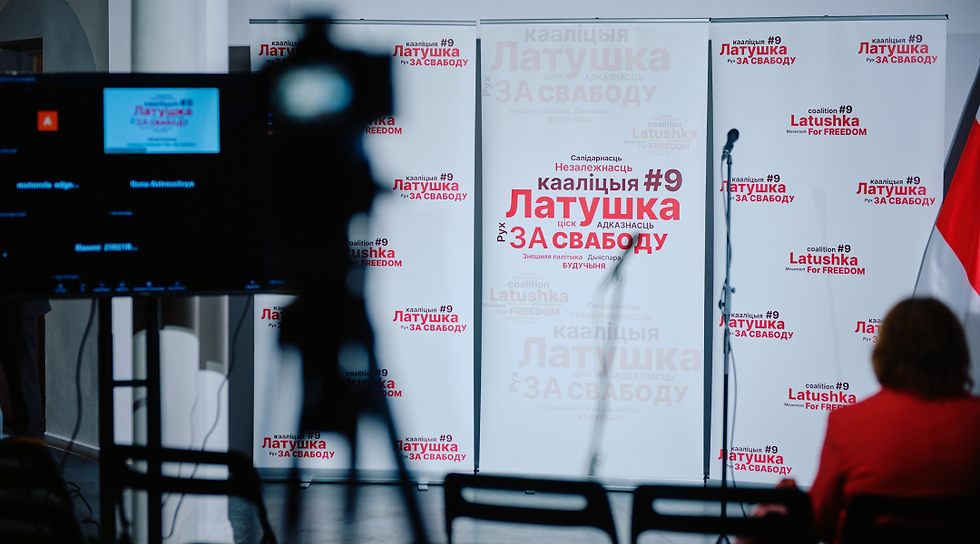
We call upon you to find the strength to vote for list No. 9 — the Coalition "Latushka and the Movement 'For Freedom'". We must preserve and strengthen our democratic institutions so that the country has a legitimate foundation for replacing the dictatorship.
The future of Belarus is hurtling toward the abyss — one cannot sit with folded hands. Vote.


Comments