


The EU Wants to Drag Itself to Lunch with Lukashenko, Where the Main Dish Will Be the Belarusian People

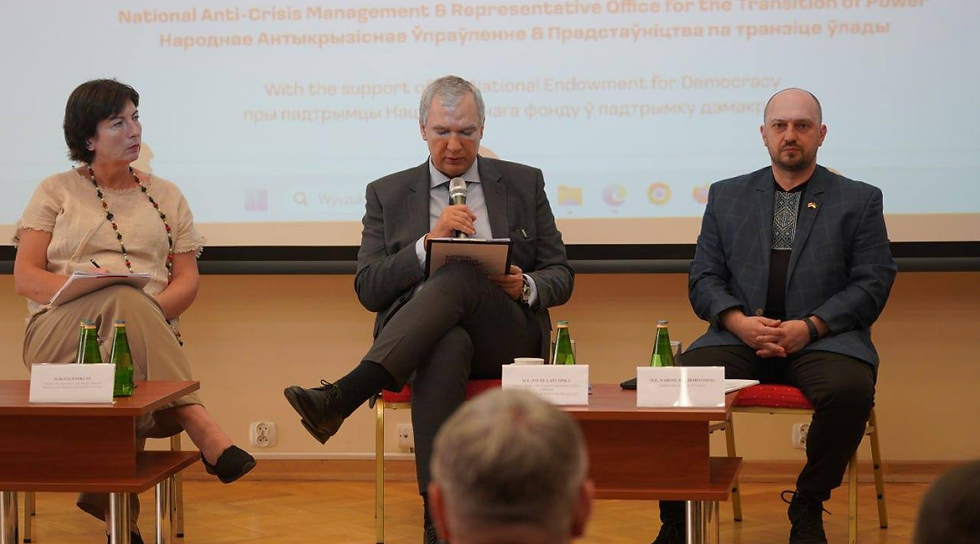
"I think the transit of power began on August 9, 2020, and it began because at that moment the Belarusian people felt their own political agency," said Deputy Head of the United Transitional Cabinet, Head of the NAM, Pavel Latushka, during the discussion panel "Don't Wait — Create a New Window of Opportunity. Challenges, Strategy, Priorities"as part of the 5th "New Belarus" Conference.
The discussion also involved President-elect of Belarus, Head of the United Transitional Cabinet Sviatlana Tsikhanouskaya; Belarusian civic and political leader Viktar Babaryka; co-chair of the Belarusian Christian Democracy party, writer, and former political prisoner Pavel Sevyarynets; and Coordination Council speaker Artsiom Brukhan.
During his remarks, Pavel Latushka stressed the importance of Belarusian democratic forces being a genuine party in any potential negotiations between the Lukashenko regime and the EU, citing the experience of EU–Lukashenko negotiations in 2014–2016, when Lukashenko released all political prisoners while the EU, for its part, moved toward an unprecedented rapprochement with the Lukashenko regime.
"But even so — for the fifth time, I stress, the fifth time — Lukashenko betrayed his European partners. He lied to them, he deceived European partners and deceived the Belarusian people. That was exactly the window of opportunity back then. Why did that happen? Because the opposition was not a party to those negotiations.
Our strategy must be based on the agency of the democratic forces. We need to have a clear position for the negotiations. Our task is to prevent European partners from making a deal with the regime along the lines of 2016, when the democratic forces were excluded. Nothing about us without us. We are a subject, not an object. The West believed Lukashenko back then, and Lukashenko betrayed that trust. And we got the horrific years of 2020 and 2022 as a result."

Pavel Latushka underlined an important difference in approaches within the democratic forces toward negotiating with the regime:
"Today there are two positions within the democratic forces. I hear one position: start talking to Lukashenko without the involvement of Belarusian society, and drag the European Union into the American-led negotiations. In effect, this is being done to drag the EU by every possible means to lunch with Lukashenko, where the main dish will be the Belarusian people. And there, they will cook us. I don't know about you, but I don't want to be the dish. I'm against it. In this situation, I want to be a subject, and to work toward the agency of Belarusian society. That's why our goal is a national dialogue — negotiations between the nomenklatura and democratic institutions, facilitated by the European Union, which has enormous tools at its disposal."
Pavel Latushka outlined 4 conditions for a transit of power in Belarus:
The presence of a strong, multidimensional crisis — which exists in Belarus today.
The presence of a foundation, a basic unifying ground for exiting the crisis — namely, independence, since 97% of Belarusians want to live in an independent country.
Pragmatists within the Lukashenko regime coming to understand that change is necessary.
"And I believe in this, because I know many of today's ministers, deputy ministers, and officials whom we spoke with before, and they are pragmatists. Of course, they cannot express their views today, but they exist."
4. Weakening of donor number one.
"Who is donor number one? The Russian Federation. And right now we're seeing long-range Ukrainian sanctions. We're seeing the cumulative effect of American and European sanctions. And once the donor is no longer able to sustain its proxy, that will be the fulfillment of the fourth condition. And that situation is approaching."
During his remarks, Pavel Latushka drew a historical parallel with Poland's transformation, when the communist authorities categorically refused dialogue with society but were nonetheless forced into it:
"We insist that pressure on the Lukashenko regime continue, that sanctions increase, and that the worst possible conditions be created for it to function. Because this window of opportunity is approaching."


Comments