


The History of the Lukashenko Regime Is a History of Political Murders

Lukashenko's crimes did not begin yesterday, and they are not happening only today. They have been occurring practically from the very first years of the dictator Lukashenko's time in power. Today I would like to discuss with a very distinguished guest those events that continue to trouble many Belarusians to this day. The years 1999–2000, the disappearances of prominent politicians: Viktor Gonchar, Deputy Prime Minister and then Chairman of the Central Election Commission, and General Zakharenko, Minister of Internal Affairs of our country.
These terrible crimes, for which accountability has still not been established, cannot simply remain in history. We must remember them when speaking of the responsibility of the Lukashenko regime for all the crimes it is committing today.
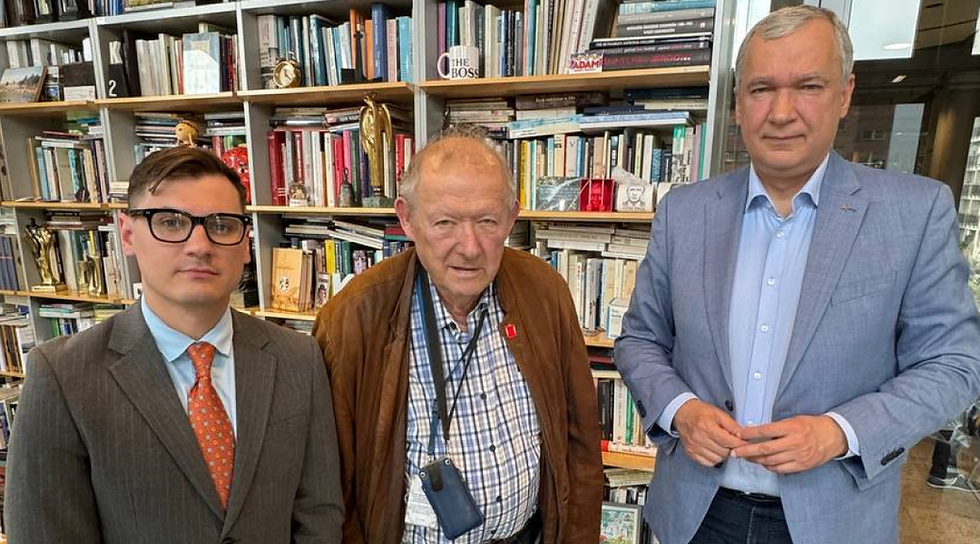
I am meeting with Mr Günter Schirmer. He is one of the most distinguished lawyers — a German jurist and international official who for decades has been a "think tank" for legal initiatives within the Council of Europe. And, as you can see, we are recording this interview in the Council of Europe itself. He is often described as one of the principal architects of Europe's legal policy on human rights and international justice. Together with Christos Pourgourides, a member of parliament from Cyprus who was appointed by the Parliamentary Assembly of the Council of Europe as rapporteur on the disappeared persons in Belarus, he visited Belarus during those years. And today I would like to put several questions to him in order to shed some light on the mysteries of those events.
Pavel Latushka:
Dear Mr Schirmer. You are rightly regarded as one of the principal architects of Europe's legal policy in the field of human rights and international justice. I would also like to sincerely thank you for agreeing to answer a number of questions that continue to trouble Belarusian society to this day.
The events of 1999 and 2000 have still not been resolved. Final conclusions have never been drawn, and we still do not know what actually happened. You were among the international experts who attempted to investigate these cases. In particular, I would like to discuss the disappearances of prominent Belarusian figures: former Deputy Prime Minister and Chairman of the Central Election Commission Viktor Gonchar, and former Minister of Internal Affairs of Belarus, General Yuri Zakharenko.
My first question, Mr Schirmer: how did you come to work with Christos Pourgourides? And when you began your work in the early 2000s, did you believe that you would actually be able to prove what had happened to Zakharenko, Gonchar, Krasovsky, and Zavadsky?
Günter Schirmer:
Well, first of all, you greatly exaggerate my role. Until my retirement last year, I was merely a staff member of the secretariat of the Committee on Legal Affairs and Human Rights of the Parliamentary Assembly. I came to join Christos Pourgourides's team because I had shortly before joined the group of lawyers and inherited this case from my predecessor — one of many cases handled by our small group. The job of a secretary is precisely to assist rapporteurs and parliamentarians in researching materials and preparing reports.
I was proud and glad to work with Christos Pourgourides. He is a strong personality, a man of principle, and a firm defender of the truth.
Did we believe that we would be able to prove who was responsible for these abductions and probable murders? It is not the role of the Parliamentary Assembly to act as a judge. We can gather clues, data, and facts. But we do not have the authority to issue judicial conclusions or verdicts. That is the prerogative of national and international courts dealing with such cases.
However, at the time Belarus wanted the Council of Europe to unfreeze its "special guest" status in the Parliamentary Assembly, which could have been a step toward joining the Council of Europe. And one of the Assembly's conditions for considering this matter was permission to conduct a PACE investigation into the allegations — which had by then become public even within Belarus itself — concerning these high-profile disappearances. Mr Pourgourides replaced the then Russian member of our committee, Sergei Kovalev, founder of Memorial, whom the Belarusian authorities considered too biased and insufficiently objective.
So by general agreement he was replaced by Christos Pourgourides. The Belarusian authorities probably underestimated Christos, who at that point was a relatively new and little-known member of the Assembly.
Pavel Latushka:
Mr Pourgourides has recounted that in Minsk, Lukashenko's agents followed you openly. Did you feel their surveillance? Did it hinder your work, or on the contrary, did it only confirm that you were getting very close to the truth?
Günter Schirmer:
Of course, there was an atmosphere of constant surveillance, especially electronic surveillance. And I felt it just as acutely as Christos did. It did not intimidate us to the point of ceasing our work, but we had to be far more cautious when meeting with unofficial interlocutors. Far more cautious.
In a sense, this atmosphere only confirmed our suspicions: if the authorities behave in such a manner, it means they have something to hide.
There was a very strange moment: on the day of meetings with officials, during lunch at the Hotel Minsk — which evidently belongs to the presidential administration — Pourgourides announced in the presence of ambassadors of Council of Europe member states that he had reached a preliminary conclusion that... And at that point the British ambassador pointed at the ceiling and said: "Be careful, we are most likely being listened to."
Pavel Latushka:
I understand.
Günter Schirmer:
Pourgourides then started again and said: "I want everyone listening right now — both those in this room and those outside it — to know: I have reached the preliminary conclusion that this country is run by a criminal gang."
The ambassadors present in the room greeted these words with applause. And evidently the authorities heard it, because they cancelled all our meetings scheduled for the afternoon. Those meetings were not particularly important, but it was clear proof that we were being listened to.
Pavel Latushka:
Understood. You met with Sheiman, Naumov, and Pavluchenko — the men who were probably behind these murders. How did they react when you asked them directly about the disappearances? Did they appear confident that they would never be held accountable?
Günter Schirmer:
Pourgourides is a practising lawyer specialising in criminal cases. He asked very specific questions. Some of them our interlocutors had clearly prepared for in advance, and their answers were carefully coordinated — they all said the same thing. But there were questions they were not prepared for, and then they began to behave in quite an aggressive manner.
For example, when Pourgourides asked Mr Sivakov, the former Minister of Internal Affairs, to explain why he had ordered the issue of an execution pistol on 7 May 1999.
Sivakov produced a rather... well, let us say, a very carefully crafted but not particularly realistic explanation. Allegedly the pistol was taken for testing, to check whether the Belarusian method of carrying out the death penalty met European standards.
Pavel Latushka:
A humanitarian.
Günter Schirmer:
"Comparative research," they said. And we asked: "In comparison with which country?" For nowhere in Europe, except Belarus, is the death penalty still applied. In any case, that answer had been prepared. But then Pourgourides asked a second question: "And what about the second time the pistol was issued, in September of the same year — which again coincided with the disappearance of another victim?"
And this time there was no prepared answer. Sivakov simply became angry and said: "Operational purposes, state secret, I cannot tell you." It was strange that he had not prepared for that.
Pavel Latushka:
A line of defence. Yes, I understand. Many dictators try to distance themselves from the crimes of their security forces, but Lukashenko openly dismissed the investigators working on these cases. In your view, was he protecting his people, or was he simply afraid they would talk and point directly at him?
Günter Schirmer:
I am sorry, but I cannot comment on that. I never met Lukashenko and cannot comment on his psychological profile or other motives.
However, in the report you can find references to instances where Lukashenko spoke and acted in a very sharp manner. Thus he was personally involved in this matter, but it is impossible to say which of the two options you mentioned is correct. Both are possible, but we cannot speculate on this.
Pavel Latushka:
Thank you for that answer. Zakharenko was an influential figure in the security forces: a former Minister of Internal Affairs, a general, a very popular man in Belarus. Gonchar headed the Central Election Commission and was a deputy in the first independent parliament of Belarus. He was also an extremely popular politician.
Why then did Lukashenko choose to kill them rather than imprison them, as he does today? We now see how many people in Belarus are behind bars for political reasons. Was he more afraid of losing power at that time?
Günter Schirmer:
Again, it is not for me to speculate, but Christos Pourgourides in fact stopped just one step short of directly accusing Lukashenko of ordering these murders.
In the report by Lopatik — the head of the criminal police — it is noted that the relevant order came from Sheiman when he was still head of the presidential administration. Other sources told us that there was a certain meeting at which Lukashenko personally gave this order. But we were unable to speak with anyone who was allegedly present at that meeting, and we cannot work on the basis of rumour.
That is why we — or rather, Pourgourides — decided not to complete the chain of evidence all the way to the top, to Lukashenko, since this was rumour rather than evidence that could withstand scrutiny in court. Of course, the people who were present could have become witnesses had they wished, but they were either ordered to remain silent or chose not to speak with us. In the end we had to stop at Sheiman and not proceed to the presidential level.
Pavel Latushka:
Mr Schirmer, when SOBR fighter Yuri Garavsky publicly confessed in 2019 to having participated in the executions, did you feel that your report had finally been confirmed by a living witness? And when a court in Switzerland acquitted him in 2023 — was that a failure of justice or simply a legal technicality?
Günter Schirmer:
Mr Pourgourides and I never encountered the name of Yuri Garavsky — only the name of the SOBR commander, Colonel Pavlichenko. And I cannot speculate as to why the Swiss court did not find Mr Garavsky's confession sufficiently convincing to deliver a guilty verdict.
In Western courts, a confession alone is often insufficient for a conviction if there is no additional evidence that the person confessing possesses so-called "criminal knowledge" — that is, details of the crime that only the perpetrator could have known. That is probably what happened in this case: beyond the confession itself, there was simply insufficient evidence to find him guilty. And so he was acquitted. In proper courts, this is standard practice.
Pavel Latushka:
Today, here at PACE, a delegation of the Coordination Council is present — the representative body of the democratic forces and Belarusian society. We pay enormous attention to the situation with repression in our country. Repression in today's Belarus is even more severe than in 1999.
The regime says: "These are matters of the distant past. Forget about them." But what is actually needed to bring these crimes before an international tribunal? Why does the Pourgourides report remain important in 2026? And do you personally believe that those responsible will face justice within our lifetime?
Günter Schirmer:
As for the last part of your question: I intend to live a long life, so — yes.
Pavel Latushka:
Thank you. That matters.
Günter Schirmer:
As for the statute of limitations: under the UN Convention for the Protection of All Persons from Enforced Disappearance, the limitation period only begins to run from the moment the fate of the disappeared person has been definitively established.
As a rule, this occurs when a body is found. Moreover, in many jurisdictions — Germany, for example — murder may be prosecuted without any statute of limitations. Thus, a future international tribunal (or the founding states of such a tribunal) will be free to reach back into the past as far as it considers necessary.
The Pourgourides report, in my view, remains relevant today, as it clearly demonstrates the true nature of the Lukashenko regime. And, as you rightly noted, the situation has not improved since then. So yes, the creation of an international tribunal is still possible, and the report can serve as important testimony to that very nature of the regime. The decision as to how far back into the past the tribunal's jurisdiction will extend will rest with its founders.
There are even precedents for the creation of such tribunals without the approval of the UN Security Council — for example, the tribunal for Sierra Leone. So even a veto by Russia cannot save the Lukashenko regime from the creation of such a tribunal.
Pavel Latushka:
My final question, Mr Schirmer, and it will be a fairly extensive one. You are aware that the prosecutor of the International Criminal Court is currently conducting investigations into crimes against humanity committed against the Belarusian people.
On 12 March, the prosecutor opened a formal investigation into the deportation of hundreds of thousands of Belarusians from the country. My team has supported this investigation, and we are actively cooperating with the Ministry of Justice of Lithuania.
At the same time, an investigation is under way into the fact that Lukashenko gave orders for the unlawful transfer of Ukrainian children from the occupied territories of Ukraine and their subsequent indoctrination in Belarus in the interests of the "Russian world." Our team has also submitted two official submissions with evidence to the ICC prosecutor's office. This case is under consideration at the ICC.
Furthermore, a Special Tribunal on the Crime of Aggression against Ukraine is currently being established. The Parliamentary Assembly of the Council of Europe is playing an enormous role in its creation. As far as I am aware, you yourself have also been actively involved in this process. In this tribunal, Lukashenko is also at the centre of attention as the person who took the decision to make Belarusian territory available for the aggression against Ukraine.
I, as a member of the democratic forces delegation at PACE, proposed the relevant amendment to a special PACE resolution. Do you consider it realistic that in the future Lukashenko and his accomplices will actually stand trial?
Günter Schirmer:
Well, there are two possibilities here. Either the regime falls, and a future democratic Belarus with a judicial system oriented toward human rights and the rule of law will do this work itself. I believe there is more than enough evidence to put Lukashenko and his henchmen on trial.
Or, with sufficient political will on the part of the international community, a special tribunal can be created. From a legal standpoint, there are no obstacles. Whether that political will will be sufficient — given the need to confront Russian aggression against Ukraine and all the current geopolitical events that are diverting attention even from Europe as a whole — I do not know. I do not know exactly when this will happen, but legally the possibility exists.
And even the fact that the "troika" of senior officials generally enjoys immunity from prosecution is not an obstacle. There are two precedents where this immunity did not apply. Immunity holds before the national courts of other states, but not before international tribunals duly established in accordance with international law.
Pavel Latushka:
Thank you very much, Mr Schirmer. I am grateful for your time and for your answers.
Günter Schirmer:
You are most welcome. Thank you.


Comments